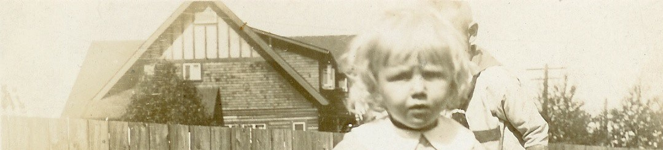
The Brock Ancestors of Philip Holton Gilbert Brock

Parents of Philip Holton Gilbert Brock
REGINALD Walter Brock married MILDRED Gertrude Britton on 28 November 1900 in Kingston Ontario. She was the youngest daughter of BYRON Moffatt Britton and MARY Eliza Holton born 19 February 1879 in Kingston Ontario. She died on 31 July 1935 enroute to hospital in Horseshoe Bay British Columbia, the day after her husband died.
Memorial of Reginald Walter Brock
by Dr. M.Y. Williams, published by the Geological Society of America June 1936.
Reginald Walter Brock was born in Perth, Ontario, on January 10, 1874. He lost his life in an aeroplane accident at Alta Lake, British Columbia, on July 30 1935.
RW Brock's grandfather, William Brock, a native of Fermanagh, Ireland, immigrated to Canada in 1849 with his wife and twelve year old son, Thomas, and settled on a farm near Petrolia. Here, Thomas Brock grew up.
In 1858, Thomas Brock was received as a minister into the old Methodist Conference. He married Marianne Jenkins, daughter of Charles Jenkins of Ottawa, Ontario, and granddaughter of John Counter, who not only was the first mayor of Kingston, Ontario, but also held that post of honour for eight consecutive years. Three children, Norma, Reginald Walter, and Stanley were born of this union.
Born and cradled in the Parsonage, Reginald Walter moved with his parents from the town of Perth in the Ottawa Valley to southwestern Ontario, living in Mount Forest, Brantford and Paris. In the vicinity, virgin forests still awaited the woodsman's ax, and gave sanctuary to a wealth of wildlife. The Mohawk Indians, of the Brantford Reserve maintained many of their primitive accomplishments, including the use of the bow and arrow. In such an environment, RW Brock spent his early boyhood, gaining a love and appreciation for wild life and considerable skill in woodcraft. Smaller game fell readily to his shaft and he longed for an opportunity to test his prowess against the larger mammals. Meanwhile, his sense of proportion was shocked by the wasteful methods of clearing the land. The burning of log heaps of oak, maple, beech, and ash, and the sale of black walnut and hickory for firewood, at the bare cost of woodcutters wages, left a lasting mental impression. The creaking oil pumps of Petrolia, which were keeping Canada well to the fore in petroleum production, called to him of the mystery of oil fields; and glacial moraines and far-travelled granite and gneiss boulders, the fossiliferous rocks of the canyon of the Grand River, and its meanders near Paris, intrigued the ever-inquisitive mind of the budding geologist.
When R.W. was twelve years of age his father died, having spent twenty-eight strenuous years in the ministry. From then on, the young schoolboy became virtual head of the family. Having attended Paris and Mount Forest high schools, he matriculated from the Ottawa Collegiate Institute in 1890 and entered Toronto University that autumn.
In the spring of 1891, RW was appointed field assistant to the veteran geologist, Dr. Robert Bell of the Geological Survey of Canada, who was working in the Sudbury district, north of Lake Huron. His initiation into field geology was inauspicious as it was portentous. Seated in the bow of his chief's canoe, the immature, seventeen year old college student broke a favourite paddle as he made his first landing. This mishap and the lecture that followed had not passed out of his mind, when an historic ax was dulled by the initiate as he attempted to help pitch camp. The chief's free expressions of disapproval had scarcely subsided, when moving a little apart; his boyish apprentice expressed his admiration of the sunset in enthusiastic whistling. There followed a stern warning to prepare to return home in the morning. Needless to say, the kindly geologist relented, and, as his boyish assistant developed rapidly into a magnificent specimen of athletic young manhood, Dr Bell grew so confident of his physical and mental ability as to give him more and more difficult tasks to perform during the five successive summers of their association.
That first summer gave RW a taste of field geology, and, what was perhaps still more important, he was associated with Willet G. Miller, a senior assistant, who became his best friend and advisor.
The winter of 1891-2 was spent as the University of Toronto and the succeeding summer with Dr. Bell and Miller.
Due to illness, RW missed a year and a half from college, but made good use of his time by acting as clerk in a lumber shanty on the Ottawa River, clerking in the mail order department of T. Eaton & Co., Toronto, and by reporting on the old Toronto News and the newly founded Toronto Star, ending up in the press gallery of the legislature. The summer of 1893 saw him back with Dr. Bell and Miller in the Georgian Bay. That autumn, Miller left the field to become a lecturer in geology at the School of Mining in Kingston, which was just opening its doors in affiliation with Queen's University. The following January, RW registered at Queens in order to study under Miller. So it was, that in the spring of 1895, he graduated from Queen's with the degree of Master of Arts, taking the medal in mineralogy and tying for the medal in chemistry.
In addition to his academic achievements, Brock made history in athletics. He was a member of the first seven of the original Toronto University hockey team, and he belonged to the Queen's hockey and football teams. The Toronto Saturday Night, of December 12 1907, stated that "for many years he figured in the final O.H.A. matches, oft on the winning teams. He took part in the historic football battle in 1896 on the Toronto campus between Queen's and Varsity when "Big Jim" Corbett remarked that " the prize ring was good enough for him".
There is a story that has been passed down by his sons that RW designed the modern hockey stick and was paid fifty cents for its design.
RW spent the winter of 1895-6 at Heidelberg, studying under Rosenbusch. During the summer of 1896 he again worked with Dr. Bell in the field, this time in northern Quebec. From Lake Shabogama, RW travelled by canoe with a Native Indian through lakes Mekiskan and Waswanipi, the Waswanipi River to Lake Mistassini; thence via Ashuapmouchouan River to Lake St. John. Much entirely unexplored country was mapped and studied, and the canoe trip with started originally at Mattawa on the Ottawa River, was approximately 700 miles. This was RW's most extensive exploration in the Pre-Cambrian Shield, and his last summer's work in eastern Canada. Moreover, during the long trip with the Indian guide, through lands inhabited almost entirely by Indians, Brock learned much of their language and customs.
The winter of 1896-7 was occupied as a lecturer in mineralogy at Queen's University, the succeeding summer being spent as an assistant to R.G. McConnell, who was starting work on the West Kootenay map-sheet of British Columbia. Thus, during his last summer as assistant, RW made his first contact with the province that was to become his by adoption. That autumn he was appointed to the staff of the Geological Survey of Canada, and was especially selected by the director, G.M. Dawson, to continue the latters work in BC. Succeeding summers were spent in the West Kootenay, Boundary and Lardeau districts.
On November 28, 1900, RW married Miss Mildred Briton, youngest daughter of the late Hon. Mr. Justice Byron Moffatt Britton, of Kingston Ontario. That winter was spent by the young couple at Heidelberg, where Brock continued his post-graduate studies. In March, Dr. Dawson died and the newly appointed Acting Director, Dr. Bell, instructed RW not to go up for his doctor's degree. Although Heidelberg was deprived of honouring him with its degree, Rosenbusch was ever free in expressing his admiration for the ability and scholarship of his young Canadian student.
In the autumn of 1902, RW was appointed professor in charge of the Department of Geology and Petrography at Queen's University, on the recommendation of Miller, who had resigned in order to organize that newly established Bureau of Mines of Ontario. The succeeding five years were busy ones for the young professor, who relieved the routine of teaching with active summers in the field, and service on numerous commissions. During this time the School of Mines grew to a leading place of engineering, training geologists who hold outstanding positions in the world of today.
During this period, RW rounded out his fieldwork in southern BC. Ö Fieldwork and teaching alike were interrupted, when on November 28 1907 RW was appointed Director of the Geological Survey and acting Deputy Minister for the Department of Mines. Selected by Dawson himself as his successor in British Columbia, it was not unfitting that he should eventually succeed to the position which Dawson had so highly adorned.
The immediate cause of Brock's appointment to the Geological Survey was the continued illness of its former director, Dr A P Low, who was elevated to the newly created post of Deputy Minister of Mines, although he was never able fully to perform his duties. Indeed a crisis had been slowly arising, which culminated when, with the setting up of the Mines Branch, plans were laid to abolish the Survey, and to combine its activities with those of a sister institution. To combat this danger, influential mining organizations had asked that Brock be appointed as Director of the Geological Survey and acting Deputy Minister of Mines. The young administrator faced a difficult task, but his accomplishments were proportional to the difficulties face. The Survey was not only saved, but it was reorganized and enlarged. The Survey was enlarged and reorganized. A Topographical branch was established under WH Boyd, and the drafting and photographic divisions were modernized. Upon moving to the newly completed Victoria Memorial Museum in 1911, scientist of standing were appointed to the various natural history divisions, and a start was made toward the development of a worthy National Museum. But it was the selection and training of scientists that RW showed his real genius. Ever opposing political preferment in the selection of staff, he made an arrangement with Canadian colleges by which recommended students were appointed as field assistants, and from these he selected the most promising for directed post-graduated work and the final appointment to his staff. This scheme had been initiated by AP Low, but Brock perfected it and made the attainment of the doctor's degree a prerequisite to an appointment. At the same time, generous leave of absence was allowed the younger men, already on the staff, in order that they might completer their post-graduate work. The reorganized institution soon gained an international reputation, in recognition of which the late C.D. Walcott, then emeritus Director of the Geological Survey of the United States and Secretary of the Smithsonian Institution, proposed himself as an honorary member of the Geological Survey of Canada.
Administrative duties prevented RW from participating in fieldwork; but in 1910, he accompanied his Excellency Earl Grey, then Governor General of Canada, on a trip to Hudson's Bay. Leaving Norway House, Lake Winnipeg, on August 8, the party traveled in 12 canoes down the Nelson River to York Factory, where they boarded the Canadian government steamer Earl Grey, crossed Hudson Bay, and sailed south along the Labrador coast to Sydney, Nova Scotia.
Having acted as Deputy Minister for seven years, RW was finally given the appointment upon the superannuation of Dr. Low, early in 1914. About this time, however, a voice was calling him back to the west; it was none other than Dr Frank F Westbrook, newly appointed president of the infant University of British Columbia. Dawson's memory, his love for, and belief in, Canada's western province, and his interest in education were all luring him away from the attractive path he was on - a path, however, often made weary by political interference and bureaucratic stagnation. As few others saw it, RW also sensed the coming world struggle, and he felt it would be easier to free himself from his new duties that from his national post of responsibility - for he never doubted that duty would involve him in overseas service. And so it was that he resigned as Director of the Geological Survey and Deputy Minister of Mines, the highest Canadian position attainable for a geologist, to become Dean of the Faculty of Applied Science in a University in the building.
Dean Brock had not yet settled in Vancouver and was, in reality, in England looking for teachers for the University, when war broke out, interrupting the building program of the University and retarding its organization. In December, Brock joined the 72nd Regiment Seaforth Highlanders of Canada, in which he rose, in 1915, to rank of Major, commanding C Company. The University of British Columbia opened its doors in the autumn of 1915 under the shadow of war, and on February 14 1916, there came into existence in Winnipeg, the 196th, or Western Universities, Battalion. The recruiting and organizing of "D" Co. (M.D. 11) British Columbia was entrusted to Major Brock, ably assisted by the late Captain O.E. LeRoy, with headquarters at the University. Major Brock was accordingly, transferred from the 72nd Seaforth Highlanders, and commanded the University Battalion at Camp Hughes until the arrival of the Commanding Officer, Lieutenant Colonel MacKay. Major Brock went to England with the Universities Battalion, where he was appointed Second-in command of the 19th Reserve Battalion (Canadian) and commanding officer of a school of map-reading and topography for the officers. The efficiency of his organization resulted in the 19th Battalion securing the training championship for the Canadian against the pick of all the British forces.
Near the end of October 1917, Capt. E.H. Corbett, of the Y.M.C.A., was sent to Seaford to organize a college in the Canadian camp, and on November 2 the Khaki College was started, with Brock representing the training school. In this way, Brock was able to utilize his ability and enthusiasm as an educator, and many of the beneficent results of the famous college are directly due to him.
Major Brock was later attached to headquarters Seaford camp and finally to the general headquarters Egyptian Expeditionary Force, as a special intelligence officer. Accompanying Lord Allenby on his successful Palestine Campaign, Major Brock reported on water supply and incidentally made a first class geological survey of Palestine. His adventures in the desert included succour and entertainment of Colonel Lawrence, and contacts with many other interesting persons. A firm friendship was established between Lord Allenby and Major Brock, the leader of the expedition always stopping with his former intelligence officer when visiting in Vancouver.
Major Brock was discharged from active service at the close of the war and returned to Canada September 1919, when he was posted to the Second Reserve Battalion. In 1928, he was transferred to the first Battalion as second in command. On the first of November 1933, he was raised to the rank of Lieutenant Colonel in command of the 72nd Seaforth Highlanders, Vancouver Division, which command he held at the time of his death.
On his return to Canada, Dean Brock threw his energy anew into the development of the University of British Columbia and more especially the Applied Science Faculty, which was directly under his charge. Every facility was given returned men to rehabilitate themselves, and several hundreds entered the various faculties, many choosing that of Applied Science. By the spring of 1935, more than forty graduates of the University of British Columbia, majoring in geology, had taken their doctorate at well-established graduate schools in England, in the United States, or in eastern Canada, and the graduates of the various department of Engineering were holding excellent positions, not only in Canada but also in many foreign lands. The great graduate schools of the world had for some time recognized both the bachelor's and the master's degree in geology from the University, as equivalent to that of any Canadian of American institution. In 1928, A.F. Buddington, in Science, pointed out that the University of British Columbia was turning out more professional geologists than any other college in America. J. Austin Bancroft, who has employed graduates of many American and European colleges in his explorations in South Africa, has expressed satisfaction with the graduates of the University.
In 1923, Brock enlarged his department to include geography, thus making the University of British Columbia the first Canadian university to provide for the teaching of this science.
But ever during his educational activities, Dean Brock sought opportunities for travel and fieldwork, just as he always encourage his staff to continue their work in nature's laboratory, the great world itself. In the summer of 1920, he did field work for the last time for the Geological Survey of Canada, in the Eutsuk Lake district of British Columbia, and carried out his program in spite of a serious knee injury received overseas.
In 1922, in company with native guides, he made a reconnaissance across the largest island of Fiji and "proved that the continent of Asia once included the Fijian archipelago" (Brock's notes). Continuing to Australia, he attended the Second Pacific Science Congress, and afterward, in company with Alfred H. Brooks, E. O. Harvey, and Nevin M. Fenneman, crossed the desert between Broken Hill and Great Cobar, visiting the important mines of the eastern half of Australia. On the homeward journey, Dean Brock made a reconnaissance of Hong Kong and the New Territories and perfected arrangement for a detailed geological survey of the Colony. This survey was carried out by the government of the Colony, Dean Brock being asked to direct it, on the advice of the British Government.
Thus, started the survey of Hong Kong. S.J. Schofield, the author, and the late W.L. Uglow spent the winters from 1923 to 1926 on the work; and Dean Brock spent the winters of 1927-1928 and 1932-1933 bringing the fieldwork to a conclusion. Although the area is relatively small, it includes hundreds of islands, and the weathered nature of the rocks and the heavy regolith make geological investigation difficult. The igneous geology is complex, and this was the first detailed survey to be undertaken in southeastern Asia, Dean Brock was most anxious to make it a standard of excellence. The geological work was undertaken while a new base map was being constructed, and when the new map was finally published, in 1931, it was evident from so much from the older map that another field season would be required in order to fit the former work into place. To this end, Dean Brock spent the winter of 1932-1933 in the Colony. The geological maps were completed by January 1935, and Brock was doing his utmost to round out the report, when so disastrously interrupted on July 30.
On his last journey home from Hong Kong, Dean Brock made studies of North China, under the guidance of the Director of the Chinese Geological Survey; of Manchuria, under the guidance of the geologist of the South Manchurian Railway; and of Korea, with the Director of the Korean Geological Survey. He also made some geological excursions in Japan and visited Kilauea under the guidance of Dr. Jaggar.
In 1929, the Province of British Columbia started an investigation of the natural resources of more than 30,000 square miles of land, set off as a subsidy to the Pacific Great Eastern Railway. Dean Brock was selected as chairman of the commission to investigated the mineral resources, the other members being professors of the University, S.J. Schofield, J.M. Turnbull, head of the department of Mining, and the writer. Dean Brock took the field and spent a busy summer, personally investigating the metallic resources. His report has played an important part in increasing the gold production of the Province.
In 1930, in connection with the continuation of the Pacific Great Eastern Survey of Resources, Dean Brock investigated crossings of the Cottonwood River for the railway.
In 1931, Dean Brock spent a week on the geology of the island of Skye, and three months on the geology of Finland, northern Norway, and Swedish Lapland, under the guidance of J.J. Sederholm. He also attended the International Geographical Congress in Paris, was a guest of British Association centenary meeting in London, and was a representative of the British Association at the Lord Mayor's dinner, Liverpool, and at the Liverpool Cathedral ceremony.
Dean Brock had served on commissions and governing boards as follows;
1903-Royal Commissioner to report on the Frank landslide.
1904-Valuator for properties entering the Consolidated Mining and Smelting Co.
1907-Valuator for the Temiskaming and Northern Ontario Railway Commission in the La Rose right-of-way case.
1909-Councillor of Queen's University.
1910-Governor, School of Mining, Kingston, Ontario.
1911-With F.T. Congdon he drafted the mining law for the Dominion of Canada.
1913-General Secretary and Treasurer of the 12th International Geological Congress, retaining this position for the Brussels Congress in 1922.
1930-1932-Member of the board of advisors of the Royal Military College of Canada (chairman 1930, 1931).
He was a member of the committee on pre-Cambrian nomenclature, and the Committee on the International Geological Map of the World. He was a Fellow of the Royal Society of Canada, the Geological Society of London, The Geological Society of America; Fellow, ex-vice president, and Chairman of Section E of the American Association for the Advancement of Science; Director, American Institute of Mining Engineers; Councillor, Canadian Institute of Mining and Metallurgy; member of the Mining and Metallurgical Society of America; honorary member of the Mining Society of Nova Scotia, the Vancouver Chamber of Mines, the Canadian Geographical Society, and the Geological Society of China; member of the Institution of Mining and Metallurgy, London and the Archaeological Society of America, and the Museum Associations.
His club membership included the Athenaeum, London; the Rideau Club, Ottawa; the Vancouver Club and the Jericho Country Club, Vancouver.
In 1921, Queen's bestowed the LL.D. degree upon him, and the University of Hong Kong honoured him similarly in 1933. On the occasion of the Jubilee celebration of King George V, in May 1935, he was granted two Jubilee Medals, and on May 24 1935, the Royal Society honoured him by electing him President.
In the autumn of 1934, the Hon. R.B. Bennett, the Premier of Canada, asked Dean Brock to accept the position of Chairman of the Harbour Commission of Vancouver. In December, this request was pressed as a patriotic appeal, on the understanding that he would be able to continue with the major part of his college duties. Dean Brock was already heavily burdened with teaching, administering his department and the Faculty of Applied Science, and he was striving to complete his Hong Kong report. Upon this national appeal, however, he placed the request before the Board of Governors of the University, and a committee of the Board advised him to accept. This he did, but he offered to contribute gratuitously his general supervision and teaching services in the University. This offer was not accepted by the Board of Governors, and Dean Brock was on a leave of absence from the University, from January 17 1935, to the time of this death. He was in charge of the Harbour Commission during the distressful days of the opening of the longshoremen's strike and was largely responsible for keeping the port open to shipping. Although thoroughly interested in the welfare of this great port, he, nevertheless, looked forward to the time when he could return to his college duties and activities. He continued his work on the Hong Kong report to the very last.
Well over six feet in height, Dean Brock was of strong, athletic build. Of fair complexion, he was commonly taken for a freshman during his professorship at Queen's, and he remained perennially youthful, not only in appearance but also physically and mentally, throughout his strenuous life. When not engaged in fieldwork, he chose golf as his means of exercise, and was noted for his long drives. In spite of an injury to a knee, received overseas, he was active in the mountains, tiring out much younger men.
Fearless and resourceful, Dean Brock had many adventures, and his bear stories of the Slocan always held an audience. He outwitted a bandit in the great Pyramid of Gizeh, pretending his pipe was a gun, and his hearty laugh caused Chinese soldiers to lower their rifles, when they captured him on a border path between Chinese and Hong Kong territory. Tense and highly absorbed when hard at work, Dean Brock was the soul of good fellowship when at mining conventions or on field parties, and his hearty songs and thrilling tales were always welcome entertainment.
On July 30, Dean Brock accompanied David Sloan, a former student of his at Queen's and the General Manager of Pioneer Gold Mines Ltd., on a trip to Gun Lake, to visit Ben Smith, a shareholder of the mine. In a plane, piloted by William McCluskey, a wartime Canadian pilot, the party flew over the mountains from Vancouver to Alta Lake, where they landed to pick up Mrs Brock, who was stopping at her summer home with her sons, David and Thomas. On taking off, the plane was caught in a down draft, causing it to collide with a stump on the mountain side. Dean Brock and Pilot McCluskey were instantly killed. Mrs Brock died on the way to the hospital ( at Horseshoe Bay), and Mr Sloan died five days later.
The love and respect of their fellow citizens were overwhelmingly accorded Dean and Mrs Brock in the largest funeral Vancouver has ever seen, the ceremony being carried out with full military honours. " Happy were they in their lives, in death not divided" was an apt summary by the press.
Five sons remain to mourn the loss of father and mother: Lieutenant Commander P. Willet Brock, of the Royal Navy of Great Britain; Byron Britton Brock, B.A.Sc., PhD., chief geologist for the N'kana Concession, Northern Rhodesia; David Hamilton Brock, B.A., barrister, Vancouver; Thomas Leith Brock, B.A., B.A.Sc., graduate of the Royal Military College, Kingston, and Lieutenant in the 1st Battalion Seaforth Highlanders of Canada; Philip Holton Gilbert Brock, student at the University of British Columbia. A brother, Stanley Brock, is in business in Montreal.
A great geologist, RW Brock may well be listed with the predecessors who directed the Geological Survey of Canada-Logan, Selwyn, and G.M. Dawson. As an educator, he compares favourably with his beloved Principal, the late George Monroe Grant, of Queen's University. A staunch Britisher, his horizon included the whole world, as he clearly showed at International Relations Congresses and in scientific assemblies of international character. Understanding men, he was a great administrator. His family life was ideal, and his intimate friends were treated as members of his family. Of rigid integrity, Dean Brock was nevertheless considerate in judgement of the mistakes of others. Such a combination of physical strength, mental power, and force of character are rarely found united, and the world is left the poorer for his untimely passing.
Vilhjalmur Stefansson, the renowned Arctic explorer, named Brock Island (located on the western edge of Queen Elizabeth Islands) in the North West Territories for Reginald Walter Brock.
The children of REGINALD and MILDRED:
1. Patrick Willet was born 30 December 1902 in Kingston Ontario; he died 10 October 1988 Haslemere Surrey England. He married (1) Muriel Doreen Collinson 1931 Havant, Hampshire; she was born 1905 Havant Hampshire and died 8 December 1974 while on holiday in West Vancouver British Columbia; he married (2) Rosemary Sylvia O. M. Harrison Stanton January 1976 Haslemere Surrey.; she was born 28 January 1926 and she died 1998 Haslemere Surrey. No children.
Patrick Willet Brock, CB, DSO, American Bronze Star, French Croix-de-Guere.
In 1914 when RW Brock became the first dean of Applied Science at UBC and head of Geology, Willet entered King Edward High School. In 1917 he became a cadet at the original Royal Naval College of Canada in Halifax. After the Halifax explosion the College reopened in Esquimalt. He graduated first in June 1920 and entered the RCN. In 1921 he transferred to the Royal Navy.
As commander of the British cruiser Kenya during the Korean War, Bill often had three Canadian destroyers under his direction-HMCS Cayuga, Sioux, and Athabascan. He won the DSO and American Bronze Star for his part in the Inchon Landings. He then became the director of operations of the Admiralty and in 1954 was promoted to Rear Admiral.
After his retirement from the Royal Navy in 1958, Bill became a naval historian and was trustee of the National Naval Museum at Greenwich. He was also a marine artist and his seven years of research on British naval ships was enhanced by his watercolour sketches of many vessels. The dossier paid particular attention to ships which visited the Esquimalt base from the 18th to early 20th century, and when completed filled one drawer of a filing cabinet.
This material was given to the Maritime Museum of BC with copies going to the Provincial Archives of BC.
Bill excelled in almost all sports - rugger, soccer, tennis, golf, running rowing in whalers and gigs, sailing. In many ships in which he served, he was the captain and coach of its interfleet cross-country run team. He always used the number 13, as being lucky; and his collection of cups and medals attests to success.
At the age of twenty-five he won the Admiralty first prize of 250 English pounds. In 1935 he won the Gold Medal in the Eardley-Wilmot Essay top award. Early on he began to write regularly for the Naval Review, the private quarterly of the RN, under his own name for serious matters and under pen names of Zilch and Beaver for lighter matters. He became so highly regarded by the editor that Bill was kept busy writing reviews of books, and commentaries of articles. For ten years he was Chairman of the Trustees of the Naval Review (1972-1982). Bill was also the vice-president of the Society for Nautical Research, and book reviewer. He was also vice-president of the Navy Records Society.
Royal Navy, Dates of Promotion
3 August 1917 Cadet, Royal Naval College of Canada, Halifax and Esquimalt, age 14
October 1920 Midshipman, RCN, age 17
12 December 1921 Midshipman, Royal Navy, age 18
1 January1923 Acting Sub-Lieutenant, age 20
1 July 1923 Sub-Lieutenant
1 October 1924 Lieutenant, age 21
1 October 1934 Lieutenant Commander, age 31
31 December 1938 Commander, age 36
12 September 1944 Acting Captain, age 41
31 December 1944 Captain, age 42
7 January 1954 Rear-Admiral, age 51
31 March 1958 Retired List, age 55
2. Byron Britton Brock was born 1 July 1904 in Kingston Ontario and died 2 April 1972 Cape Town South Africa; he married Barbara Grote Stirling on 21 November 1929 in Kelowna British Columbia; she was born 1906 Erpingham Norfolk and died 11 August 1978 Cape Town South Africa. They had two children.
The following was written by Professor D. A. Pretorious of the Economic Geology Research Unit of the University of Witwatersrand at the request of the Geological Society of America to be included in their Year Book as a Memorial to BBB.
Brit Brock was born in Kingston, Canada, on July 1, 1904, and died in Cape Town, South Africa, on April 20, 1972. He started on the shores of Lake Ontario and ended at the fairest cape in all the world, and in between were sixty-eight years as a boy in Canada and as a student, sailor, labourer, hobo, & geologist in Canada, Hong Kong, Yugoslavia, England, the United States, East, West, Central and Southern Africa, Persia, Israel, Cyprus, Singapore and Madagascar. He studied rocks, sketched and painted, played the flute and clarinet, sailed the sea, and called himself a happy wanderer. He believed that his life should fit a pattern which had meaning, that he should live for the present, that he should do his best in everything he undertook, thus precluding wasted time on regrets and self-recrimination in the event of a failure, and that those simple rules plus the fatalism engendered of wartime seafaring would combine to make a contented and satisfying life. He once said that what he craved for more than anything else was the time to do all the things he wanted to do. Brit Brock was still looking for that time when he died, his life still full of things he wished to do.
His father, Reginald Brock, resigned in 1914 as Director of the Geological Survey of Canada to become the first Professor of Geology at the University of British Columbia, where he subsequently was made Dean of Applied Science. Brit Brock’s son Patrick, is presently teaching geology at Queen’s College, Flushing, New York. Over three generations, the Brock family has made a not inconsiderable contribution to the science and practice of geology.
After junior school in Ottawa and high school in Vancouver, Brit Brock attended the Royal Naval College of Canada at Esquimalt, British Columbia, and qualified as a midshipman at just the time the Canadian Navy virtually ceased to exist as an institution. He nevertheless served a year at sea on less elegant vessels before entering the University of British Columbia from which he graduated with a B.Ap.Sc. Degree in 1926. He then joined the Geological Survey of the Colony of Hong Kong as an assistant geologist. In 1927-8, he undertook mineral exploration in Yugoslavia for Selection Trust Limited, and in 1929-30 worked on the Britannia Mining Company’s silver mine in British Columbia.
By this time, the tide of the Great Depression was beginning to rise, and, on the closing down of the mine, Brit, when back to the University of British Columbia where he lectured in elementary civil engineering during 1931. As the times became harder, he quit his only experience of academic life, and went to work as a labourer. Even such employment soon came to an end, and with no prospect of gainful work, he tried hoboing. In the futility of such activity, Brit decided the only way to ride out the economic depression was to borrow money and return to university for his doctoral degree. Between stints in Yugoslavia and British Columbia, he sampled St. John’s College, Cambridge, and Queen’s University, Kingston, but his choice in 1932 fell upon the University of Wisconsin in Madison. Here he was to encounter, in full flower, the second great love of his professional life. In British Columbia, he was charmed by the sea; in Wisconsin, he became infatuated with structural geology. He obtained his Ph.D. in 1934, only to find that the Depression had in no way abated and that North America was in no dire need of geologists.
In this atmosphere of gloom, an expatriate Canadian offered to show Brit Brock another world in which he was destined to spend the rest of his life. Joseph Austen Bancroft was Dawson Professor of Geology at McGill University in Montreal when, in 1927, Sir Ernest Oppenheimer of the Anglo American Corporation of South Africa persuaded him to leave the groves of academe for the endless bush of Northern Rhodesia. From the Copperbelt was to be mounted possibly the greatest exploration programme that African metal mining has seen. In 1934, Brit accepted a one-year contract with Bancroft’s team and departed for Northern Rhodesia. Seventeen years were to elapse before he saw Canada again. For the rest of his life, he was to live in South Africa.
From 1934 to 1941, Brit served as manager of the Rhokana Field Division, and gained intimate experience of the great copper deposits along the Congo-Zambezi watershed. As World War II continued, as the lure of the sea became stronger, and, in 1941, he left Northern Rhodesia and joined the Royal Navy Volunteer Reserve in South Africa, as a first lieutenant. He subsequently transferred to Kenyan RNVR, and saw service in Kenya, the Persian Gulf, the United Kingdom, Burma, and Singapore. He was demobilized in South Africa early in 1946, and returned to the Anglo American Corporation being based in Johannesburg, South Africa.
Brit acted as assistant to the Consulting Geologist, Dr. J. A. Bancroft, from 1946 to 1952, and when the latter retired in 1952, was appointed Consulting Geologist to the Anglo American Corporation. For thirteen years he occupied this position, retiring in 1965. In the post-war years, he became deeply involved in the intensive prospecting for further gold and uranium mineralization in the Witwatersrand Basin, and he played a significant role in the discovery and opening up of new mines in the Far West Rand, Kerksdorp, and Orange Free State goldfields. He was also responsible for establishing and consolidating many of the geological departments on the individual gold mines, and in this way considerably enhanced the status of geology in the mining industry of South Africa. He retired in 1965, and went back to live by the sea, in the historic naval dockyard of Simon’s Town, on the Cape of Good Hope.
Brit Brock’s contributions to the advancement of geological knowledge were in the fields of synthesis and structural geology. Africa was the first framework within which his ideas developed and his work progressed. He first became involved in synthesis in Northern Rhodesia where his prime responsibility was to correlate and evaluate all the bits and pieces of geological knowledge gathered by Bancroft’s exploration team of geologists, mining engineers, and prospectors operating in the northwestern part of Northern Rhodesia and the southern part of the Belgian Congo. The importance of the structural setting to the localization of the ore-bodies became more and more apparent as this work proceeded, and Brit gained the first glimpse of a grand design to the architecture of the African continent. When his activities were transferred to the Witwatersrand goldfields, he was presented with further evidence of the relationship between structure and mineral deposits. He was forced to cultivated strength in three-dimensional thinking in order to decipher the subsurface geometry of sedimentary environments favourable to gold and uranium mineralization. From such thinking began his interest in the fragmentation of the sphere that is the earth. He became convinced that structural geology, in any form, could not be viewed as an exercise in plane geometry.
From this premise he launched himself into a long-view survey of the whole surface of the Earth, with particular emphasis on Africa. He maintained, to the end, that this continent held the key to unraveling the complex history of crustal evolution. The state of exposure and preservation of the full time-range of Precambrian rocks gave Africa a decided advantage over other parts of the world. He developed the concept of structural mosaics, each bounded by well-defined lineaments, at the intersections of the latter of which structural vertices developed. In these vertices, conditions were especially favourable for the development of many unique geological environments and for the emplacement of significant mineral deposits. He also firmly subscribed to the hypothesis that the dominant structural force affecting the Earth’s crust was vertical tectonics. He first examined the Vrodefort ring structure, in the Witwatersrand Basin, in the light of this belief, and then extended his studies to the East African rift valleys. The crustal plates, of varying size, making up the hierarchy of mosaics, remained rigid and moved up and down only, relative to each other. Severe compression was confined to the linear zones separating the rigid plates. As the theory of structural mosaics advanced, so related concepts were formulated: the ubiquity of arcuate structures; the aliquot principle; structural great circles which have been intermittently active throughout their length; vertices as geomorphological centers; gradation in the order of size of geological features dependent upon time, from the Archean to the Tertiary. At all times, he advocated that structural studies of large regions should proceed from the general to the particular, contrary to normal practice, and that a globe of the world was the correct starting place.
Research along those lines culminated in the presentation of a pattern of orogenic evolution, with particular reference to what could be seen in the geology of Southern Africa. The linear mobile belts between the cratonic plates were seen as the sutures in a mosaic hierarchy. The finer mosaics are the oldest and the coarsest are the youngest, with a graduation in between. There is an apparent constant ratio between the lengths of linear sections of the sutures and the diameters of the bounded cratons. The lengths of the mobile belts increase exponentially with the decreasing age. The number of orogenic belts per era increases with time, from two in the Tertiary to thousands in the Archean.
Brit Brock did not confine his thinking to the continents. His sea-faring background made it natural that he should also consider the geometry of the ocean basins and the significance of the size-shaped relationships of island arcs. Having seen a systematic pattern in the fragmentation of the surface of the Earth, Brit decided to look at the other celestial bodies. He first examined the geometry of lunar features, and then extended his studies to the Massian lineaments. He concluded that the tectonic pattern of the moon, like that of the earth, is integrated with the spherical shape.
All the work and thinking of Brit was directed towards formulating a grand strategy of mineral exploration. He believed that the mosaic hierarchy provided the structural framework within which the metallogenic provinces are set. The principle of repetitive patterns has an application to mineral patterns as well as mosaic patterns, since the two are related. The spacing of mineral centers, when seen to be an orderly arrangement, is a reflection of an ordered structural pattern.
In addition to his contributions to original geological though, Brit Brock served his science admirably through his activities in professional societies and his encouragement of research at universities in England and South Africa. He was a Fellow of the Geological Society of America, a Fellow of the Geological Society of London, a Fellow of the Royal Geographical Society, and a member of the Geological Society of South Africa, the Society of Economic Geologists, the American Geophysical Union, the Institution of Mining and Metallurgy, and the Canadian Institute of Mining and Metallurgy. From 1963, he was a member of the I.U.G.S’s World Commission of Mineral Distribution. He served as Regional Vice-President for Africa of the Society of Economic Geologists between 1960 and 1963. He was first elected to the Council of the Geological Society of South Africa in 1950, and continued in this capacity until he voluntarily stood down in 1966, consequent upon his retirement from the mining industry. Brit was President of the G.S.S.A. in 1957-8, and in 1961, this Society awarded him its Draper Medal in recognition of his distinguished contribution to South Africa geology. He played a leading role in the establishment of the Institute of African Geology at Leeds University in England, of the Economic Geology Research Unit at the University of Witwatersrand, and of the Precambrian Research Unit at the University of Cape Town in South Africa. His active interest in all three over the years contributed greatly to the progress of these research groups specializing in geology of the African continent.
Brit Brock had 29 publications to his credit. He spent his retirement years synthesizing all his observations and ideas into his magnum opus “ A Global Approach to Geology; the Background of a Mineral Exploration Strategy based on Significant Form in the Patterning of the Earth’s Crust”. This book appeared shortly after his death. In addition to his scientific publications, Brit derived satisfaction from the Quarterly News Bulletin of the Geological Society of South Africa, which he started in 1958 and of which he continued as editor up to 1965. Not only did he edit the bulletin, but he wrote most of the copy for it and drew the illustrations. This source of pleasure was replaced, upon his retirement, by his activities in the Simon’s Town Historical Society. He contributed to the half-yearly bulletin, and designed and produced four brochures on various aspects of the history of the naval dockyard. When he died, Brit had all but completed for publication an annotated photographic album of the historic buildings of Simon’s Town.
In 1929, while working in British Columbia, Brit Brock married Barbara Grote Stirling. Through the hard Depression years in Canada and America, the years of isolation in the Northern Rhodesian bush, the war years, and the years of achievement and fulfillment in South Africa, his wife contributed immeasurably to the goodness of Brit’s life and the realization of his hopes and ideals. She survives him and continues to live in the Cape Peninsula. He also leaves a daughter, Elizabeth Mary Robertson, who resides in Johannesburg, and a son Patrick Willet Brock of, Flushing, New York.
Just a year before he died, Brit Brock wrote: “ South Africa, with its abundance of firsts among natural phenomena, should be studied de novo…. The erstwhile dark continent could become a source of light”.
*Notes for family written by Ba Brock.
Brit did not actually leave UBC in 1931 to go to work as a labourer. He thought he was engaged as a geological engineer at Trail, but finding himself number 75 on the waiting list, he took the labouring job to go on with. He left this to go back to University and study. The hoboing was to get to and from his thesis area, not a deliberate way of life. St John’s was between Yugoslavia and Britannia. Queen’s was after Trail while waiting to get into Wisconsin, having decided against MIT and being turned down by Princeton.
3. David Hamilton Brock was born 31 July 1910 in Ottawa Ontario and died 8 September 1978 in West Vancouver British Columbia. He married Margaret Isobel Coulthard on 28 July 1937 in Vancouver British Columbia. She was born in 1911 in Vancouver and died 14 September 1997 in West Vancouver British Columbia. They had four children.
Third son of Reginald Walter Brock and Mildred Britton. David Brock was a well known writer, broadcaster and television personality. He was best known for his quips, talks and documentaries on the CBC (Hourglass, Seven O’Clock Show, B.C. Viewpoint, and Good Morning Radio). He was regularly published in Punch, Saturday Night under B.K Sandwell’s editorship, Atlantic Monthly and the Night and Day in the 1930’s and 1940’s. Later he wrote humorous columns for the Vancouver Province, Vancouver News and Herald and the Victoria Times (“Chips off the old Brock”) and for many years wrote editorials under the pseudonym D. Badger for the Western Miner.
He attended the University of British Columbia. He was called to the bar but never practiced. Dave attended Harvard University’s graduate school where he studied English.
4. Thomas Leith Brock was born August 12 1912 in Ottawa, Ontario. He died 3 January 1993 in Victoria British Columbia. Tom married Vera Phyllis Primrose Robson in September 1937 at St John's Church in North Vancouver, BC. She was born 3 July 1907 Pinner Harrow Hill, Middlesex; she died 7 March 1990 Victoria British Columbia.
Tom had all his schooling in Vancouver. He attended the University of British Columbia 1928-1930 and 1934-1937, obtaining the degrees of BA, BASc. (chemical engineering) and MASc. (Chemical Engineering).
From 1930-1934 he was a cadet at the Royal Military College of Canada, Kingston. Diploma of graduation, and offered a commission in the Royal Artillery (British Army), but elected to continue university education. In 1937-1942 he studied advanced chemical engineering at the Massachusetts Institute of Technology, Boston. He joined the Aluminum Company of Canada (Alcan) in 1938 at Arvida, Quebec and retired in 1978 after 40 years service, to Victoria, BC. He was in London, England from 1953-1956 connected with Alcan’s operations in Commonwealth countries.From 1970-1977 Corporate Secretary of Alcan, in Montreal.
They had 3 children.
5. PHILIP Holton Gilbert Brock was born on 22 August 1914 in Ottawa Ontario the youngest son of REGINALD Walter Brock and MILDRED Gertrude Britton; he died in Penticton British Columbia, on 14 September 1995. He married JUNE Alice Ashton on 3 July 1952 in St Andrew's United Church, North Vancouver, B.C; she died 20 March 1999 in Penticton B.C. They had five children.
From notes written 15 September 1995 by his son Peter Brock.
Philip Holton Gilbert Brock was known to all as Pip, a gentleman who did interesting things and told fascinating stories, most of them true, to an admiring audience of friends who not so secretly wished they had as many wonderful adventures as Pip had.
Pip was an explorer and an athlete, who spent his young childhood climbing mountains and skiing well before it became a popular pastime. He has several first ascents of BC mountains to his credit, and climbed with the well known Phyl and Don Munday in the Waddington area. He also climbed in Switzerland. In later life, when his children were nearly grown, Pip started to hike and climb again, spending time in Cathedral, Manning, and where it all began, Garibaldi Park. It was these mountain trips which confirmed that Pip was no ordinary retiree, and he took great pleasure in breaking the mold. He celebrated his seventy-fifth birthday six years ago in a mountain hut on the slopes of Mount Joffre.
It should be noted that he never climbed “because it was there. He did it because he loved the alpine, and he loved the accomplishment of getting to the high country, where he could relax and enjoy the incredible beauty.
In between his early adventures Pip earned a Science degree in Agriculture, graduating in 1938 from UBC. UBC has become the traditional alma mater for the family, and the institution was the object of considerable interest by Pip, because of his parents’ close involvement with its early beginnings.
Pip was a keen voyager, and travelled extensively throughout the United States on his Harley motorcycle. Before the war Pip did the Grand Tour of Europe also traveling to Asia and India. Pip served as a lieutenant and trained to be a commando officer during the war, and afterwards he continued roaming, this time by sports car.
Pip was also a highly capable sailor, who sailed the South Seas in the 1940’s in his own 40 foot ketch, the Escapee. He cruised the BC coast for a long time afterwards, and met his wife along the way. He also owned the Fleetwood and another ketch.
By the early 1950’s Pip was starting to settle down. He married June Ashton, and together they raised five children. Pip spent most of his working life with the Water Survey of Canada, a career which was well-suited to him. His work there required great amounts of travel, wilderness treks, and detailed technical paperwork together in one profession. Although he began his career in Vancouver, in 1966 he relocated his family to Penticton to live in its wonderful climate.
In later life, Pip enjoyed reading, writing and rhythm. He was a good musician, who played drums in many dance bands over the years after taking up the instrument at the age of fifty. He also had a beautiful tenor voice which found good use in church choir. Not surprising for a mountaineer, he could yodel quite convincingly, which made for a grand show on the snow covered peaks.
Pip was quite an unsung humorist—not many people could fire off puns and funny quips as fast as Pip could. There were many groaners and repeats, no question, but enough new good ones kept coming to delight us to surprise even Pip himself.
Pip was a nature lover, indeed, but he was especially a strong friend of animals. It didn’t really matter if it was a cat, a dog, a horse or even a pig, he loved them all. He spoiled them with treats and attention, much like the way he encouraged children with gifts of affection.
Pip was very hardworking, and many will remember how he enjoyed strenuous physical work outside, and how he kept the grounds of his West Bench property in park like condition. He needed his chores to stay happy. He used to look forward to snow so he could venture outside and shovel off the driveway. He didn’t like labour saving devices. If there was a hard way to do something, Pip preferred it. He was an excellent helper in the house, always there to help with the kitchen and table chores.
Speaking of tables, Pip loved food—of all kinds—and was known as a real gourmand, with a large appetite to go with it. Meal times are the only times he can’t be pictured with his pipe, a reliable constant about Pip if there was one. It was part of his signature appearance: a tall, slim good looking man with an air of good health and happiness.
Pip was a real gentleman, a popular person known for his polite and courteous manner. Always very considerate and thoughtful of others, Pip was proud to be noble and unselfish. He could be relied on for a kind and respectful remark, one who made people feel welcome and wanted. Pip noticed the small things, the things important to each of us, but mostly unnoticed by others as they focus on their own situation. Pip wouldn’t pass by someone’s accomplishment with offering a few words of appreciation. It was nice to be noticed by Pip.
BROCK Grandparents of Philip Holton Gilbert Brock
Reverend THOMAS Brock was born on 3 April 1837 in County Fermanagh, Ireland (1851 1881 Canadian Census); he died 18 July 1886 in Mount Forest, Ontario. He married MARION N. Jenkins on 3 November 1869 in Ottawa Carleton County Ontario. She was born 1 November 1847 in Kingston Ontario to CHARLES William Jenkins and CAROLINE Counter (1861 1881 1891 Ontario census); she died 10 May 1931 in Vancouver, B.C. but was buried Mount Forest, Ontario.
In 1858, he was received on trial as a Wesleyan Methodist preacher to assist Rev. William Savage at Mount Bridges, CW. In 1859, he was in Romney, CW., and in 1860, in New Ireland, CE. He was a student at Victoria College, Cobourg, CW in 1861. In 1862, Thomas was received into full connection, ordained, and stationed at Newcastle, CW. He was at Newburg in1863, Clinton in 1864, Galt in 1865, Georgetown in 1866,Milton in 1867, Kingston in 1868, and Parkenham and Arnproirin 1869-70.
Between 1871 and 1874, Thomas was stationed in Perth, ON. In the latter year, he was transferred to the London Conference. In 1877 he was transferred to Dublin St., Guelph, and, in 1879, to Brant Ave., Brantford. He was a delegated to the General Conference of 1878, and financial secretary from 1877 to 1880. (Dan Brock, Brocks of Killymore, County Fermanagh)
Children of THOMAS and MARION Brock:
-
1.Marian Norma was born 6 December 1871 in Perth Ontario. She died 27 October 1897 in Kingston Ontario. She was unmarried.
-
2.REGINALD Walter 1874-1935
-
3.William Stanley was born 21 October 1879 in Brantford Ontario; he died 3 February 1953 in Montreal Quebec but was buried in St John’s Cathedral Cemetery in Winnipeg Manitoba. He married Edith Emma Codd on 24 December 1904 at St Luke’s Winnipeg Manitoba. She was born 18 January 1881 in Winnipeg and she died 30 November 1863 in Montreal but was buried next to her husband in Winnipeg. They had three daughters.
Excerpt from "Who's Who in Canada 1936"
President, Stanley Brock Limited, Montreal, Quebec, operating in Montreal, Winnipeg, Calgary and Vancouver (est. 1905), operates and controls Rumford Ltd., Winnipeg Rumford Laundry Ltd., Brandon; Rainbow Laundry & Zoric Dry Cleaners Ltd., Regina; Past President, American Institute of Laundering, U.S. and Canada.
Educated: public and high schools, Mt. Forest and Kingston, Ontario.
Born Brantford, Ontario, 21 October 1879, son of Reverend Thomas and Marion Brock. Educated at Toronto, Ontario. Commenced career with J. Dick & Company, bag manufacturers, Toronto. Came to Winnipeg, 1900; President, Rumford Laundry Company; President, Brandon Steam Laundry; Director, Standard Ideal Company, Port Hope, Ontario. Married Edith Codd, Winnipeg, 1904; has two daughters. Clubs and Society: Manitoba; Carlton; Assiniboine; Commercial Travellers; AF & AM. Recreation: hunting. Protestant. Address: 117 Rose Street, Winnipeg.
Source: Who’s Who in Western Canada: A Biographical Dictionary of Notable Living Men and Women of Western Canada, Volume 1, 1911. C. W. Parker, editor. Canadian Press Association, Vancouver.
Began business career as freight clerk, C.P.R., Winnipeg, 1897; Manager, John Dick Limited, Winnipeg 1899; in business for himself, Winnipeg, 1901; organized Stanley Brock Ltd in Winnipeg, 1905, and became President, Troy Laundry Machinery Co. Ltd., Chicago, U.S. 1913; President, 1915 and 1923. Moved to Montreal, 1923.
Clubs: Marlborough Golf; Laval-sur-le- Lac Golf; Manitoba (Winnipeg); Carleton (Winnipeg); St Charles Country (Winnipeg); Vancouver ( Vancouver, BC).
Societies: A.F. & A. (Knight Templars); 32nd Degree Scottish Rite, A.A.O., N.M.S.; Life Member, St John's Lodge No. 4 (The Grand Lodge of Manitoba); King Edward Preceptor and Priory No. 24 and Prince Rupert Chapter No. 1, Winnipeg.
Recreations: golf, snow-shoeing, fishing.
Residence: 1582 Pine Avenue, West Montreal, Quebec.
BROCK Great-Grandparents of PHG
WILLIAM Brock was born in 1808 in Killymore, Inishmacsaint Parish, County Fermanagh, Ireland; he died on 22 March 1889 in Petrolia Ontario. He married SUSANNAH Brock on 29 January 1833 in the Chapel of Ease, Slavan, Ireland. She was born about 1811 in Fermanagh Ireland and died 31 August 1876.
WILLIAM emigrated from Ireland with his family and arrived in Canada in May 1849. The family first settled in London Township and then around 1856, they settled in Enniskillen Lambton Ontario.
The children of WILLIAM and SUSANNAH:
-
1.Mary was born 1834 Ireland (1851 1871 1881 Canada Census). She died 14 February 1918 in Vancouver B.C. but was buried in Enniskillen Ontario. She married William Dundas 3 May 1867 Sarnia Ontario. He was born 1838 Fermanagh Ireland (1881 Canada census) and died 1 June 1889 Enniskillen Ontario and was buried in Hillsdale Cemetery. They had five children.
-
2.Robert was baptised 16 November 1834 Inishmacsaint Fermanagh Ireland
-
3.Robert was born December 1835 Enniskillen Fermanagh Ireland and died 19 September 1899 Enniskillen Ontario. He married his first cousin Anne Brock daughter of his Uncle George about 1867. They had ten children.
-
4.THOMAS 1837-1886
-
5.Elizabeth Brock was born about 1840 Fermanagh Ireland (1851 Canada census)
-
6.Catherine Brock was born July 1845 Ireland (1851 Canada census) and died 3 March 1872 Plympton Ontario. She married John Dundas 16 March 1869 Sarnia Ontario. They had three children.
CHARLES William Jenkins was born 1814 in London England (1861 1871 1881 1891 Canada census). CHARLES William died 7 April 1900 in Ottawa and was buried in Cataraqui Cemetery, Kingston. He married CAROLINE Counter on 29 July 1840 in Kingston Ontario. CAROLINE was born 24 September 1825 in Kingston Ontario. She was the eldest daughter of JOHN Counter and HANNAH Rood; she died 28 March 1890 in Kingston Ontario and was buried at Cataraqui Cemetery.
The children of CHARLES and CAROLINE:
-
1. Caroline N was born 31 July 1841 in Kingston Ontario. She married Frederick George Thomas Bradley. They had three children.
-
2. C.O. was born 19 April 1843 Kingston Ontario (1861 Canada census)
-
3. Hannah Elizabeth was born about 1845 in Kingston Ontario (1861 1871 Canada census). She married Isaac Hencherman Price, a barrister about 1867 most likely in Kingston. He was born about 1842. They had five children.
-
4. MARION N 1847-1931
-
5. Alice Maud Louisa was born 20 January 1849 in Kingston Ontario. She married Richard Austin Bradley 12 October 1871 in Ottawa Ontario. He was born January 1845 in Gloucester Ontario and died 15 August 1916 in Ottawa Ontario. They had five children.
-
6. John C was born 1850 in Kingston Ontario. (1861 Canada census) He is also a witness at the wedding of his sister Alice in 1871.
-
7. Charles was born 1856 and buried Cataraqui Cemetery Kingston Ontario 8 December 1893. Not proven.
-
8. Harvey Henry was born 1857 Kingston Ontario (1861 Canada census)
-
9. Frank Maurice Stinson was born 6 July 1859 Kingston Ontario; he died 5 December 1930 Ottawa Ontario and buried Beechwood Cemetery 8 December. He married Annie Margaret Lampman on 10 August 1892 in Ottawa Ontario. She was the daughter of Archibald Lampman and Susanna Charlotte Gesner. They had four children.
ENCYCLOPEDIA OF CANADIAN MUSIC
Jenkins (b Lampman), Annie (Margaret). Pianist, organist, choir director, teacher, b Morpeth, near Chatham, Upper Canada (Ontario), 14 May 1866, d Ottawa 12 Jul 1952. A sister of the poet Archibald Lampman, she studied piano with J.D. Kerrison and Waugh Lauder, organ with Edgar Doward in Toronto, and piano 1887-9 with Martin Krause in Leipzig. In 1889 the Leipzig critics praised her clear and delicate performance of the Grieg Concerto. Krause considered her Bach playing a very model. In Ottawa, where Lampman had settled in 1885, she appeared in recital as early as 1886, playing Schumann's Fantasy, Opus 17, the piano part in the same composer's Quintet, Opus 44, and other music. She became a teacher at Ottawa's Martin Krause School of Pianoforte Playing and Singing (named for the Leipzig teacher and propounding his methods) and later at the Canadian Conservatory of Music (Ottawa), teaching voice and piano.
For more than 20 years Lampman was organist-choirmaster at St George's Church. She was a charter member of the Morning Music Club of Ottawa and its president 1920-8. In 1921 she founded the Palestrina Choir, which emphasized unaccompanied singing, and until late in life she remained active as accompanist and teacher. She was Canada's first outstanding woman pianist, but the limited professional opportunities in Ottawa during her lifetime inhibited the development of her gifts to the full.
In 1892 Lampman married Frank Maurice Stinson Jenkins (b Kingston, Upper Canada, 6 Jul 1859, d Ottawa 5 Dec 1930), founder and conductor of the Ottawa Amateur Orchestral Society (1894-1900), the Ottawa Choral Society and the Schubert Club (1894), and organist at several Ottawa churches. Their daughter Dorothy Jenkins McCurry (b Ottawa 6 Nov 1899, d there 29 Aug 1973) was a noted music teacher, choir director (Studio Singers), and musical organizer in Ottawa. Papers documenting the careers of all three are held by the National Library of Canada. Author Helmut Kallmann
Brock Great-great-Grandparents of PHG
ROBERT Brock was born about 1766 in Killymore, Inishmacsaint, Fermanagh, Ireland. In September 1776 he was described as the "sixth son of the said Thomas Brock the elder of the age of eight years". He married ELIZABETH Weir about 1795 in Killymore Fermanagh Ireland. She died before 1849 in Ireland. After his wife's death, Robert immigrated to Canada in May 1849 and lived with his daughter, Mary in Adelaide Middlesex County, Canada West. They settled first in London Township also in Middlesex, and in the mid or late 1850s moved to Enniskillen, Lambton County. Source: Dan Brock, Brocks of Killymore County Fermanagh.
Children of ROBERT and ELIZABETH:
1. Mary was born 2 September 1796 Killymore Fermanagh; she married John Johnston on 17 December 1818 by licence in Inishmacsaint Parish. John was a captain, possibly in the Upper Canadian militia. Mary is believed to have been a widow, living in Adelaide C.W in 1852. Some time thereafter she went to live with her son, Alexander Johnston who lived in Moore Lambton County. Mary died on 18 June 1889, and was interred in the Froomfield Cemetery, Moore. They had four children.
2. Thomas was born 2 October 1798 Killymore Fermanagh; he died 2 June 1878 in Wyoming Ontario. He married Margaret E Burgess Weir about 1830 in Ireland. She was born about 1809 in Ireland and died 2 July 1879 Wyoming Ontario. They had twelve children.
3. George Brock was born 4 May 1803 Killymore Fermanagh; he died 26 April 1885 in Adelaide Ontario. He married (1) Mary McCourt 25 January 1830 in Christ Church Montreal Quebec. They had three children. He married (2)Isabella Moore 13 November 1834 in Christ Church of Montreal Quebec. They had nine children.
4. Robert Brock was baptised 28 April 1805 Killymore Fermanagh Ireland. He married Ann Kent on 2 July 1824 in St Gabriel Street Presbyterian Church in Montreal Quebec. They had one child.
5. WILLIAM 1808-1889
THOMAS Brock was born 1765 in Killymore, Inishmacsaint Parish, County Fermanagh, Ireland; he died in 1824. He married ELIZABETH.
The children of THOMAS and ELIZABETH:
-
1. Ruth was born 1803 Fermanagh Ireland; she died 20 November 1879 Sarnia Ontario. She married John Dundas. They had three children.
-
2. SUSANNAH 1808-1876
-
3. Catherine was born 1823 Fermanagh Ireland; she died 23 April 1903 Point Edward Ontario. She married George McKee 1846 Enniskillen Ireland. They immigrated to Canada West in 1847. They had twelve children.
-
4. Elizabeth was baptised 16 May 1824 in Slavan. She married Francis Carson 18 December 1849 in Slavan Ireland. They had two children.
-
5. Eleanor was married 4 May 1830 in Inishmacsaint Parish to Charles Leith also of the same parish.
JOHN Counter was born 18 April 1799 in Tavistock Devonshire and baptised May 1799 in the Abbey Chapel Presbyterian in Tavistock(Dict. of Canadian Biography); he died 26 October 1862 in Kingston, County Frontenac and was buried in Cataraqui Cemetery on 26 October 1862. He married HANNAH Rood on 18 April 1822 in Kingston Ontario. She was born on 1 March 1805 in Kingston and baptised on 16 June 1805 the daughter of HARVEY Rood and CATHERINE Burnett in the Anglican Church in Kingston. Rev. J. Stuart Ang. Parish Reg. 1784-1811. HANNAH died 1861 in Kingston County Frontenac of consumption and was buried in Cataraqui Cemetery.
DICTIONARY OF CANADIAN BIOGRAPHY
COUNTER, JOHN, baker, entrepreneur, and politician; b. 18 April 1799 in Devonshire, England, second son of Susannah and John Counter; m. in April 1822 Hannah Roode of Kingston, Upper Canada, and they had six children, two dying in infancy; d. 29 Oct. 1862 at Kingston.
John Counter came to Kingston with his parents about 1820. At first a baker and confectioner, he later expanded his commercial interests into transportation and real estate. In 1831 he bought waterfront land in Kingston and a year later built a handsome combined residence and commercial building (demolished in 1973) which he named Plymouth Square. He had added to this building three times by 1840 and had also extended his waterfront holdings.
Counters first recorded investment in Kingston was in August 1826 when he bought a £25 share in the Cataraqui Bridge Company. In January 1836 he formed, and was first chairman of, the Kingston Stave Forwarding Company based on Garden Island opposite the town. A joint stock company, it became Calvin, Cook, and Counter in 1838. Counter left the firm in 1843, and Delano Dexter Calvin and Hiram Cook expanded the business to include shipbuilding; the firm continued until 1914. Counter also formed the Marine Railway Company for ship repair and shipbuilding in April 1836. He started it with his own capital, then opened it to public subscription. It expanded into supporting industries and came to include a sawmill, an iron foundry, extensive shops, and wharfage rights.
At a public meeting on 30 Dec. 1835 Counter moved a resolution, seconded by John Mowat*, urging the incorporation of Kingston as a town. Counter continued to promote the measure, judging that it would bring increased business and improve property values, and signed the petition which finally brought incorporation in 1838. He sought a council seat in the town’s first election but was defeated. However, he served as mayor in 1841, 1842, and 1843, and was the first mayor of the city of Kingston in 1846. Elected again in 1850, 1852, 1853, and 1855, he resigned in June 1855 because his shares in the local gas company were considered to constitute a conflict of interest. In 1851, Counter, whose politics were expressed as Kingston, was nominated by the Reformers to run against John A. Macdonald* in the Kingston City riding but he refused to campaign. He did oppose Macdonald in 1854 but received only 265 votes to Macdonald’s 437.
Counter had been instrumental in forming the Board of Trade in Kingston in December 1839. As its president (he was the first to hold that post) he organized in 1841 a canvass of the town to find accommodation for government officials when Kingston became the home of the parliament of the united Province of Canada, giving up his own home to the vice-chancellor, R. S. Jameson*, and renting the new offices of the Marine Railway to the government. In 1842, as mayor, he went to England to borrow money so the town could erect a municipal building befitting the then capital of the province [see William Coverdale]. With Macdonald he gave a clock for the tower of the new building, completed in 1844, which became the city hall when Kingston was incorporated as a city in 1846. A strong supporter of the Wesleyan Methodists, Counter donated generously to the building fund for the Victoria Street chapel in 1847. He gave the land and laid the cornerstone, on 17 April 1851, for the Sydenham Street Church, and he served on its management committee.
Before the Grand Trunk Railway came to Kingston in 1856, Counter started a car ferry to Cape Vincent (N.Y.), hoping to make Kingston the distribution centre for American goods in Canada. To speed up and improve this service he promoted the Wolfe Island, Kingston, and Toronto Railroad and the Wolfe Island Railway and Canal Company. The latter project, a canal across Wolfe Island, which he had conceived in 1836, was incorporated in 1851 and finally put in operation in 1857. By then, other railways provided alternatives to the Cape Vincent-Kingston route and it was completed too late to be profitable.
Counter borrowed heavily to support his numerous interests and also to open the first subdivision in Kingston. In 1852 he had the highest assessment in the city. In October 1855 he could not meet a large mortgage payment and his financial obligations forced him into bankruptcy. At the time Counters business enterprises began to fail his personal life was beset with tragedy. Within ten years he lost his brother, two grandchildren, his two sons, and his wife. The country house he built in 1847, named South Roode to honour his wife, was taken over by a bank in 1856, the same year that his extensive holdings were disposed of by chancery sale.
John Counter died six years later at the home of his son-in-law, in virtual obscurity. Only a brief notice appeared in the local newspaper on the death of a man who had devoted his life to the welfare of his adopted home.
Margaret S. Angus
Anglican Church of Canada, Diocese of Ontario, Synod Archives (Kingston, Ont.), St George’s parish register, 1822. Cataraqui Cemetery (Kingston, Ont.), gravestones. Kingston Registry Office (Kingston, Ont.), records for water lot 22; park lot 2 and subdivisions; and farm lot 22, east 1/2. PAC, RG 31, 1861 census, Kingston City, ward 2. QUA, Kingston Town Council, proceedings, 1838-45; Kingston City Council, proceedings, 1846-55. British Whig and General Advertiser for Canada West (Kingston, [Ont.]), 7 April 1838, 21 Nov. 1843, 29 Jan. 1844. Chronicle & Gazette (Kingston), 20 April 1835; 2, 16, 23 Jan., 2 March, 20 April 1836; 7 Dec. 1837; 17 Aug., 7 Dec. 1839; 7 March 1840; 24 Feb., 7 April 1841; 7 April, 16 May 1842. Chronicle and News (Kingston), 7 Dec. 1848, 11 Aug. 1849, 14 Jan. 1853, 16 March 1855. Daily News (Kingston), 18 July 1854; 12 June, 10 Oct. 1855; 28 March 1856; 2 Nov. 1861; 29 Oct. 1862. Kingston Chronicle, 7 Aug., 15 Sept. 1826. Creighton, Macdonald, young politician, 140, 171. E. E. Horsey, Kingston, a century ago; issued to commemorate the centennial of Kingston’s incorporation (Kingston, Ont., 1938).
© 2000 University of Toronto/Universite Laval
The children of JOHN and HANNAH are:
1. CAROLINE 1825-1890
2. John was born December 1825 Kingston and died in August 1826. He was buried 4 August 1826 aged 9 months in Kingston Ontario.
-
3. John Henry was born 1827 Kingston Ontario (1861 census)
-
4. H.L. was born 1839 Kingston Ontario (1861 census)
-
5. Charles was born 1842 Kingston Ontario (1861 census)
-
6. Unknown died 15 January 1860 Kingston Ontario (1861 census)
Brock Great-great-great Grandparents of PHG
THOMAS Brock of Killymore, Inishmacsaint Parish, Co. Fermanagh, Ireland.
In 1753, a marriage licence bond was drawn up for THOMAS Brock and MARGERY Breen in Inishmacsaint Parish. THOMAS Brock's name appears in the vestry meeting book for the years 1765-1788 inclusive, for the Middle Division of Inishmacsaint Parish, and he was churchwarden in the 1780s. In 1769, THOMAS Brock of Killymore leased 43 acres, 3 roods, and 7 perches (17.7 ha) of land in the adjoining townland of Curnadarum, which was also in Inishmacsaint Parish, from the Rt. Hon. Nicholas Hume, Earl of Ely, for a yearly rent of £10 for the lives of Thomas, his 10-year-old daughter Margaret, and John Johnston, about 13 years old, third son of Thomas Johnston of Farrancassidy, Co. Fermanagh.
On 21 Sept. 1776, Thomas Brock, Sr. and Thomas Brock, Jr.,together with Thomas Hall and Thomas McKee leased 239 acres, 1 rood, and 13 perches (96.9 ha) in Killymore, effective 20 Sept. 1776, for £25.6.6 per annum. The rent was to be paid semi-annually in November and May. The lease was to run for three lives, namely, that of eight-year-old Robert Brock, sixth son of Thomas Brock the elder, 18-year-old, John Hall, only son of Thomas Hall, and Charles Fraser Frizell, about 11 years old, eldest son of Richard Frizell,Esq. of Rathfarnham, Dublin Co., Ireland.
Thomas Brock of Killymore possessed a house and land and had his vote registered at Enniskillen in 1796 and, with his partner, was £13.17.10 in arrears in rental to the estate of the Rt. Hon. the Earl of Ely in Nov. 1793. Dan Brock, The Brocks of the Townland of Killymore
The children of THOMAS Brock and MARGERY Breen:
-
1. Mary born about 1759 Inishmacsaint Parish County Fermanagh Ireland.
-
2. Francis Brock was born 2 May 1760 Killymore Inishmacsaint Fermanagh; he died in February 1826 York Township. He married (1)Isabella Ingraham about 1786 in Killymore; she died about October 1794 in Killymore. They had five children. He married (2)Judith MacTage on 25 December 1796 New York NY; she died about 1837 in York Township Upper Canada. They had twelve children.
-
3. John was born about 1765; the name of his wife is not known and it is believed that they had six children.
-
4. THOMAS 1765-1824
-
5. A son about 1765 Killymore and died 1776, age 11.
-
6. Another son born about the same time and died 1776
-
7. ROBERT 1766-
-
8. William was born about 1772 in Killymore; he married Catherine Strong about 1804 in Killymore, Fermanagh. They had four children.
JOHN Counter was born about 1774 most likely in Devon England; he died 23 September 1826 in Kingston Ontario. According to the U.C. Gazette and Loyalist and the Kingston Chronicle JOHN sr was 52 years old when he died. He married SUSANNAH about 1796 no doubt in Devon. SUSANNAH was born 1769 probably in Devon. An excerpt from the first Century in Methodism in Canada Vol. II 1849-51 p. 68. “Mrs Susannah Counter, came with her husband to Kingston in 1822. After many years of faithful service and much affliction she died, August 9th 1849, aged 80.”
The children of JOHN and SUSANNAH:
-
1.Robert was baptised 26 March 1797 in The Abbey Chapel Presbyterian in Tavistock Devon.
-
2.JOHN 1799-1862
-
3.Susannah was born 20 May 1801 Tavistock and was baptised 7 June 1801 in the Brook Street Independent Chapel in Tavistock Devon.
-
4.Thomas was born 28 June 1802 in Tavistock and was baptised 1 July 1802 in the Brook Street Independent Chapel in Tavistock Devon.
-
5.William was born 30 August 1803 in Tavistock and was baptised 13 September 1803 in the Brook Street Independent Chapel in Tavistock Devon.
-
6.Susannah was born 22 September 1805 in Tavistock and baptised 2 October 1805 in the Brook Street Independent Chapel in Tavistock Devon.
-
7.Sally was born 18 January 1807 in Tavistock and was baptised 28 January 1807 in the Brook Street Independent Chapel in Tavistock Devon.
HARVEY Rood was of Kingston. He married CATHERINE Burnett; she was born about 1759 and she died 1857 in Kingston Ontario in her 98th year. They had one child (that I know of).
Sources
-
1.Ontario Canada Marriages, 1801-1926
-
2.Ontario Canada Deaths, 1869-1934
-
3.Ontario Canada Births, 1869-1909
-
4.England & Wales Death Index; 1837-2005
-
5.England & Wales Marriage Index, 1916-2005
-
6.Marriage Notices of Ontario, 1813-1854
-
7.Cataraqui Cemetery Burial Registers, 1853-1924
-
8.Quebec Vital & Church Records (Drouin Collection), 1621-1967
-
9.Archives of Ontario, Marriage Registration
-
10.England & Wales Birth Index; 1837-1915
-
11.New York Passenger Lists, 1820-1957
-
12.Dictionary of Canadian Biography
-
13.Social Security Death Index
-
14.Kingston Chronicle and Gazette
-
15.British Columbia Death Index
-
16.The first century of Methodism in Canada
-
17.The Loyalists in Ontario, The Sons and Daughters of American Loyalists of Upper Canada
-
18.Parish of Lethingsett Norfolk; St Andrews
-
19.Upper Canada Gazette and U.E. Loyalist
-
20.Parish of East Dereham Norfolk; St Nicholas
-
21.Immigrants from England 1800-1900, Vol. 1 & 2 Frontenac County and Lennox and Addington County.
-
22.Parish of Tavistock Devonshire; Brook Street Chapel Independent 1796-1836
-
23.Manitoba Morning Free Press 1905 Jan 4
-
24. 1861 1871 1881 1891 Canada Census
25. The Brocks of the Townland of Killymore by Dan Brock